Wadi Coffee Roasters
Colombia EA Decaf de Caña - Huila
Colombia EA Decaf de Caña - Huila
Regular price
$21.00
Regular price
Sale price
$21.00
Unit price
per
Couldn't load pickup availability
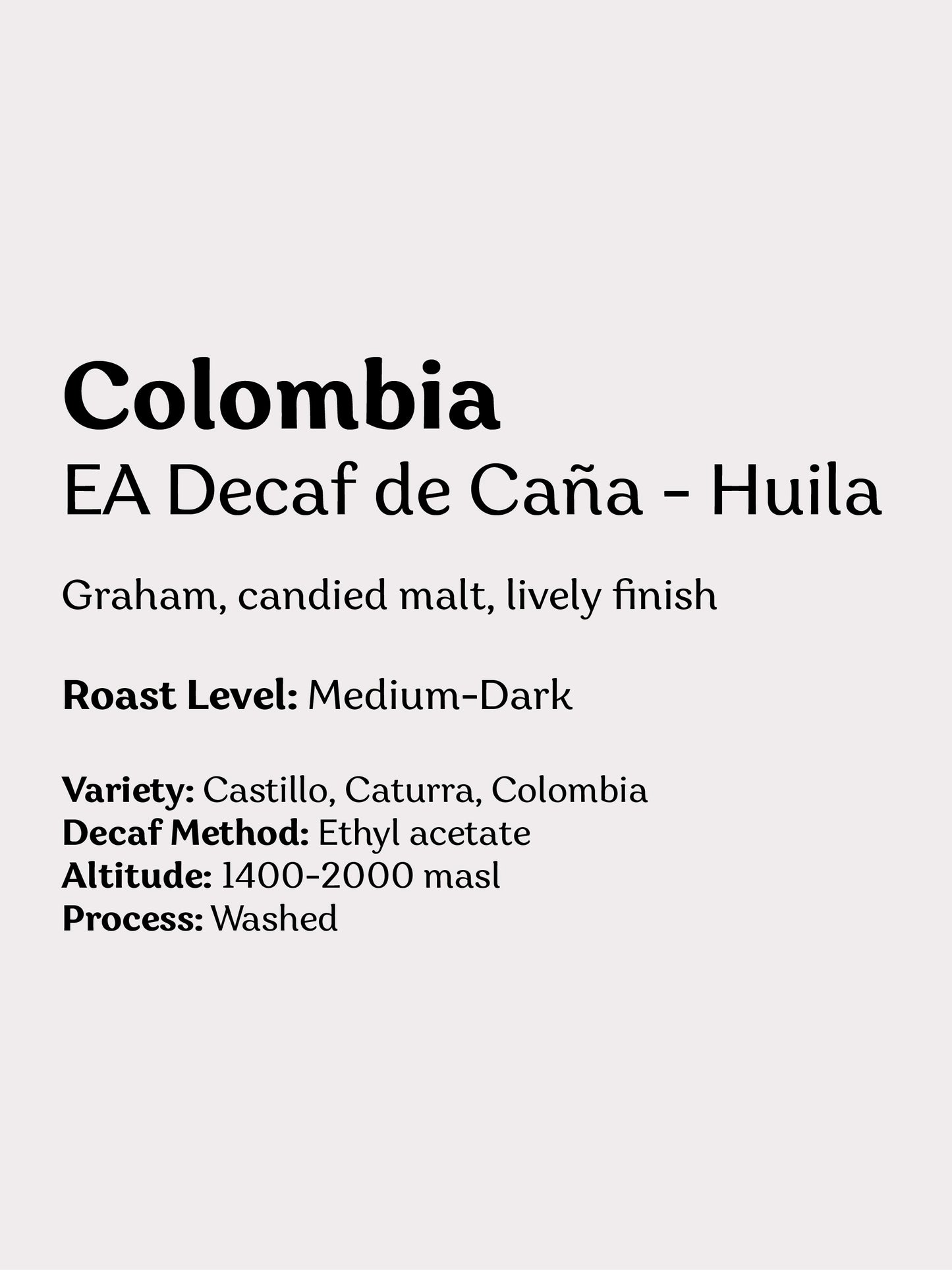
Origin: Huila, Colombia
Producer: Smallholder farmers
Altitude: 1400–2000 masl
Variety: Castillo, Caturra, Colombia
Process: Washed
Decaf Method: Ethyl Acetate (de Caña)
Roast: Medium-Dark
Tasting Notes
Graham · Candied malt · Lively finish
About This Coffee
This decaf comes from smallholder farmers in Huila, one of Colombia's most celebrated coffee regions, nestled between the Central and Eastern Andes, where elevation, climate, and a dense concentration of small farms consistently produce some of the country's most expressive cups. Huila accounts for nearly 20% of Colombia's production, and yet 80% of its farmers work on less than three hectares. It's that scale of attention that shows up in the cup.
The coffee is decaffeinated using the Ethyl Acetate (EA) de Caña method, a naturally derived process that uses ethyl acetate, a compound found in fermented sugarcane, to gently remove caffeine while preserving the coffee's character. The result is a decaf that actually tastes like coffee: warm, rounded, and satisfying. Graham cracker sweetness, a malt-like body, and a lively finish that lingers longer than most decafs let themselves.
Roasted to a medium-dark profile, it's a reliable everyday cup, great black, equally good with milk.
How EA Decaffeination Works
Ethyl acetate is a naturally occurring ester, found in bananas and as a byproduct of fermented sugars, used as a solvent to bond with and draw out caffeine from green coffee. The beans are first steamed under low pressure to open their pores, then submerged in a water-and-EA solution where the compound bonds to caffeine molecules. The tank is drained and refreshed over eight hours until no caffeine remains. A final steam removes any traces of EA before the beans are dried and prepared for export. EA is only harmful in concentrations far above what remains in the finished coffee.